
DevOps has transformed the way organizations develop, test, deploy, and manage software applications. By bridging the gap between development and operations teams, DevOps enables faster software delivery, improved collaboration, and greater reliability. However, achieving these benefits requires the right set of tools.
Modern DevOps practices rely heavily on automation, continuous integration, continuous delivery, monitoring, and infrastructure management. Whether you are a beginner entering the DevOps field or an experienced engineer looking to expand your toolkit, understanding the most popular DevOps tools is essential.
In this article, we will explore the best DevOps tools every engineer should know and how they contribute to building efficient and scalable software development workflows.
Git – Version Control Foundation
Git is one of the most fundamental tools in the DevOps ecosystem. It is a distributed version control system that allows developers to track code changes, collaborate with team members, and manage software projects effectively.
Key Benefits:
- Tracks code history and modifications
- Supports team collaboration
- Enables branching and merging
- Facilitates code reviews and pull requests
Popular Git hosting platforms include GitHub, GitLab, and Bitbucket. Every DevOps engineer should have a solid understanding of Git because it serves as the foundation for modern software development workflows.
Jenkins – Continuous Integration and Continuous Delivery
Jenkins is one of the most widely used automation servers for implementing CI/CD pipelines. It automates the process of building, testing, and deploying applications.
Key Benefits:
- Open-source and highly customizable
- Supports thousands of plugins
- Automates repetitive development tasks
- Integrates with numerous DevOps tools
Organizations use Jenkins to streamline software delivery and reduce manual intervention in deployment processes.
Docker – Containerization Platform
Docker revolutionized software deployment through containerization. Containers package applications along with their dependencies, ensuring consistency across different environments.
Key Benefits:
- Lightweight and portable
- Faster application deployment
- Eliminates environment inconsistencies
- Simplifies application scaling
Docker allows developers to create applications that run reliably on any system, making it an essential tool for modern DevOps teams.
Kubernetes – Container Orchestration
As organizations adopt containerized applications, managing large numbers of containers becomes challenging. Kubernetes solves this problem by automating deployment, scaling, and management of containerized workloads.
Key Benefits:
- Automated container orchestration
- Self-healing capabilities
- Load balancing and scaling
- High availability and reliability
Kubernetes has become the industry standard for container management and is a must-learn technology for DevOps professionals.
Ansible – Configuration Management and Automation
Ansible is an open-source automation tool used for configuration management, application deployment, and infrastructure provisioning.
Key Benefits:
- Agentless architecture
- Easy-to-read YAML configuration files
- Simplifies infrastructure management
- Automates repetitive operational tasks
Ansible enables DevOps teams to manage servers and environments consistently while reducing human error.
Terraform – Infrastructure as Code
Terraform, developed by HashiCorp, allows engineers to define infrastructure using code. This approach is known as Infrastructure as Code (IaC).
Key Benefits:
- Automates infrastructure provisioning
- Supports multiple cloud providers
- Improves consistency and reproducibility
- Enables version-controlled infrastructure
Terraform helps organizations build and manage cloud infrastructure efficiently while maintaining scalability and reliability.
Prometheus – Monitoring and Alerting
Monitoring is a critical component of DevOps. Prometheus is an open-source monitoring system designed to collect and store metrics from applications and infrastructure.
Key Benefits:
- Real-time monitoring
- Powerful querying capabilities
- Custom alerting rules
- Excellent Kubernetes integration
Prometheus helps teams identify performance issues before they affect users, improving overall system reliability.
Grafana – Data Visualization
Grafana is commonly used alongside Prometheus to visualize system metrics through interactive dashboards.
Key Benefits:
- Real-time data visualization
- Customizable dashboards
- Supports multiple data sources
- Easy monitoring of application performance
Grafana provides clear insights into system health and helps DevOps teams make data-driven decisions.
GitLab CI/CD
GitLab offers an integrated DevOps platform that combines source code management, CI/CD pipelines, security testing, and project management in a single solution.
Key Benefits:
- Built-in CI/CD functionality
- Enhanced collaboration
- Security scanning capabilities
- Streamlined development workflows
Many organizations prefer GitLab because it provides a complete DevOps lifecycle management solution.
AWS DevOps Tools
Amazon Web Services offers a wide range of DevOps services designed to automate software delivery and infrastructure management.
Popular AWS DevOps services include:
- AWS CodePipeline
- AWS CodeBuild
- AWS CodeDeploy
- AWS CloudFormation
Key Benefits:
- Cloud-native automation
- Seamless AWS integration
- High scalability
- Enterprise-grade security
AWS tools are particularly valuable for organizations running applications in cloud environments.
Azure DevOps
Azure DevOps is Microsoft’s comprehensive DevOps platform that supports planning, development, testing, and deployment activities.
Key Features:
- Azure Repos
- Azure Pipelines
- Azure Boards
- Azure Test Plans
Key Benefits:
- Integrated development environment
- Strong Microsoft ecosystem support
- Enterprise-level scalability
- Comprehensive project management
Azure DevOps is especially popular among organizations using Microsoft technologies.
ELK Stack – Log Management
The ELK Stack consists of:
- Elasticsearch
- Logstash
- Kibana
Together, these tools provide powerful log collection, analysis, and visualization capabilities.
Key Benefits:
- Centralized logging
- Faster troubleshooting
- Real-time log analysis
- Improved operational visibility
Effective log management is essential for maintaining application performance and quickly resolving incidents.
Why DevOps Engineers Need Multiple Tools
No single tool can handle every aspect of the DevOps lifecycle. Successful DevOps teams typically combine several tools to create a complete workflow.
A common DevOps toolchain might include:
- Git for version control
- Jenkins for CI/CD
- Docker for containerization
- Kubernetes for orchestration
- Terraform for infrastructure provisioning
- Ansible for configuration management
- Prometheus and Grafana for monitoring
- ELK Stack for logging
By integrating these tools, organizations can achieve faster deployments, improved reliability, and greater operational efficiency.
Future Trends in DevOps Tools
The DevOps landscape continues to evolve rapidly. Some emerging trends include:
AI-Powered Automation
Artificial intelligence is helping teams automate testing, monitoring, and incident management.
GitOps
GitOps uses Git repositories as the single source of truth for infrastructure and application deployment.
Platform Engineering
Organizations are building internal developer platforms to simplify software delivery processes.
Enhanced Security Integration
DevSecOps practices are integrating security checks directly into CI/CD pipelines.
Engineers who stay updated with these trends will remain competitive in the evolving technology landscape.
Conclusion
DevOps has become a critical practice for modern software development, enabling organizations to deliver applications faster and more reliably. The right tools play a crucial role in achieving DevOps success.
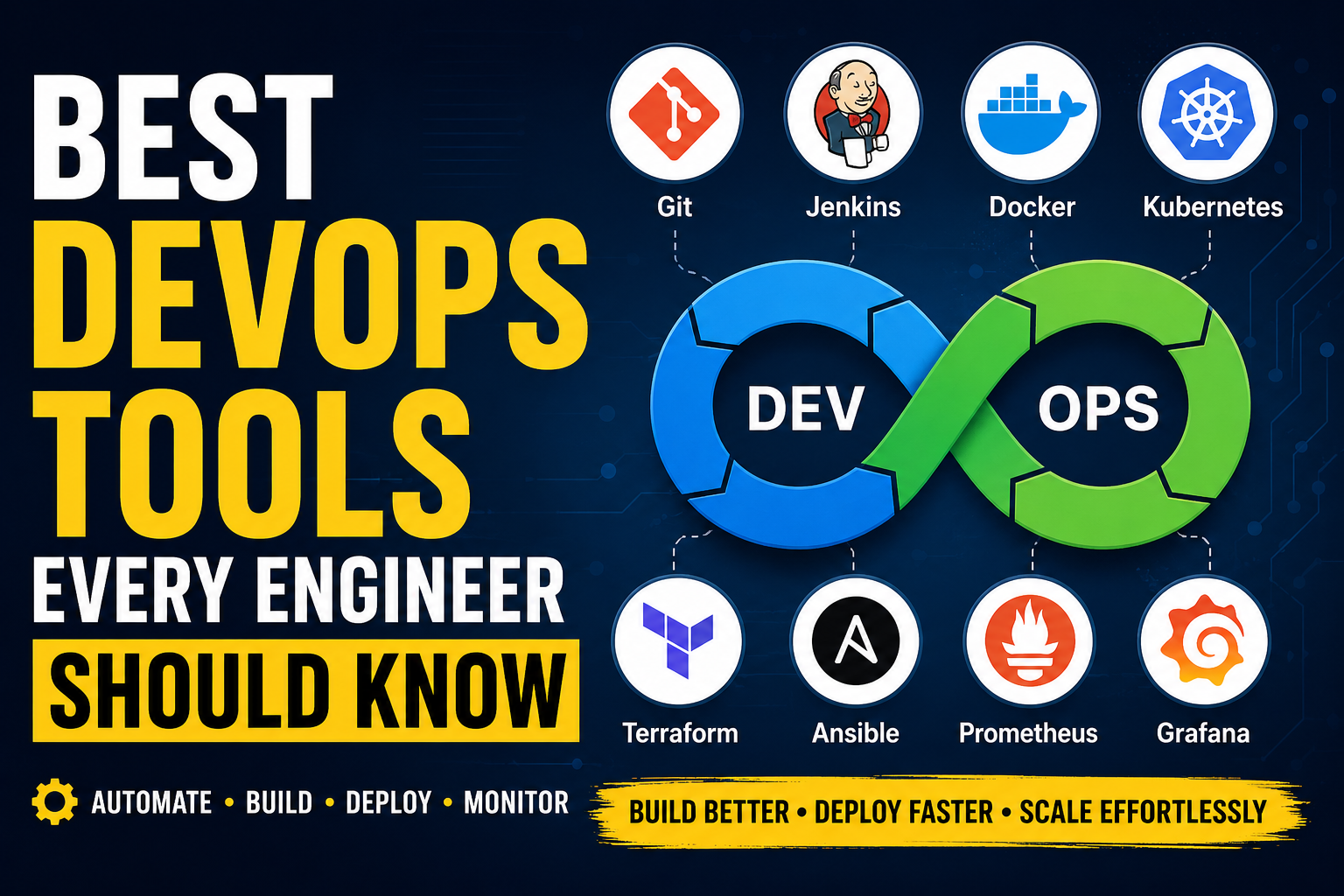
Git, Jenkins, Docker, Kubernetes, Terraform, Ansible, Prometheus, Grafana, GitLab, AWS DevOps services, Azure DevOps, and the ELK Stack are among the most valuable tools every DevOps engineer should know.
Mastering these technologies will not only improve your technical skills but also enhance your ability to build scalable, automated, and resilient systems. As businesses continue to embrace cloud computing and digital transformation, expertise in DevOps tools will remain one of the most in-demand skills in the technology industry.
Which DevOps tool should beginners learn first?
Beginners should start with Git because it is the foundation of version control and collaboration. After mastering Git, learning Docker, Jenkins, and Kubernetes can help build a strong DevOps skill set.
Is Kubernetes necessary for DevOps engineers?
Yes, Kubernetes has become one of the most important DevOps tools for managing containerized applications. It automates deployment, scaling, and monitoring, making it a valuable skill for modern DevOps professionals.
What are the most commonly used DevOps tools in 2026?
Some of the most popular DevOps tools include Git, Jenkins, Docker, Kubernetes, Terraform, Ansible, Prometheus, Grafana, GitLab CI/CD, and AWS DevOps services. These tools help automate software development, deployment, infrastructure management, and monitoring processes.