

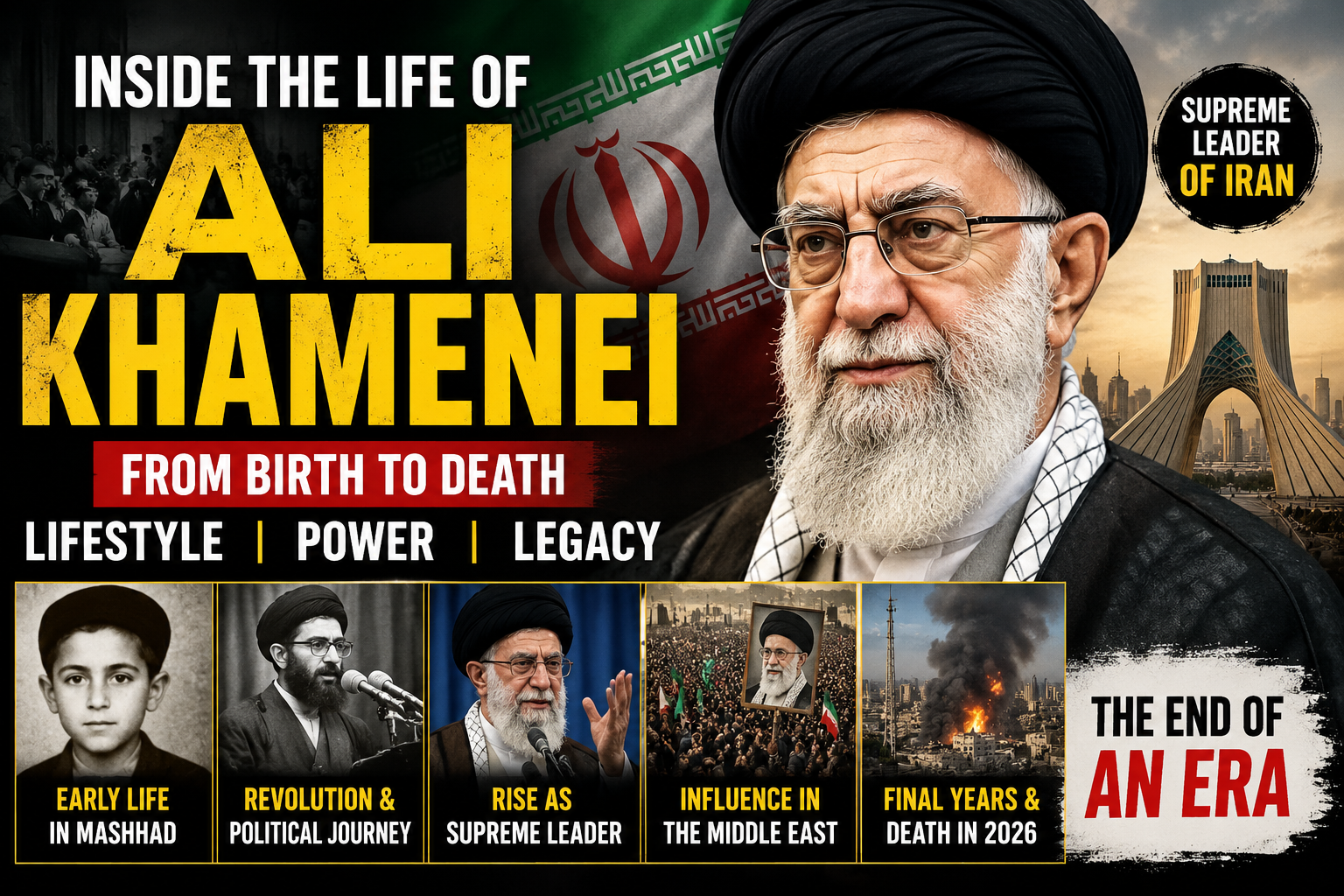
Ali Khamenei was one of the most influential and powerful political leaders in the modern Middle East. For more than three decades, he ruled Iran as the country’s Supreme Leader and shaped its political, military, and religious direction. His life journey started from a religious family in Iran and later transformed into a story of power, leadership, controversy, and global influence. From his early education to his political rise and strict lifestyle, Ali Khamenei remained one of the most discussed figures in world politics.
Early Life and Childhood
Ali Khamenei was born on 19 April 1939 in Mashhad, a religious city in Iran. He belonged to a modest religious family. His father, Javad Khamenei, was an Islamic scholar who focused heavily on religious teachings and discipline. Growing up in a simple household, Ali Khamenei spent most of his childhood studying Islamic education, Arabic literature, and religious philosophy.
From a young age, he showed interest in religious leadership and political ideas. During his studies, he became influenced by revolutionary Islamic scholars, especially Ruhollah Khomeini, who later became the founder of the Islamic Republic of Iran. Khamenei strongly supported the movement against the Shah of Iran, who was accused of corruption and close relations with Western countries.
Political Struggles and Revolutionary Activities
During the 1960s and 1970s, Iran experienced major political unrest. Ali Khamenei actively participated in speeches, protests, and revolutionary campaigns against the Shah’s government. Because of his political activism, he was arrested multiple times and reportedly faced torture and imprisonment by Iranian security agencies.
Despite these challenges, Khamenei continued supporting the Islamic Revolution led by Ayatollah Khomeini. In 1979, the Iranian Revolution successfully removed the Shah from power, and Iran officially became an Islamic Republic. This revolution completely changed the political system of the country and brought religious leaders into power.
After the revolution, Ali Khamenei quickly rose in politics because of his loyalty to Khomeini and his strong revolutionary image.
Becoming President of Iran
In 1981, Ali Khamenei became the President of Iran during a difficult period in the country’s history. Iran was fighting a deadly war with Iraq, known as the Iran-Iraq War. The war caused massive destruction, economic pressure, and military challenges.
As president, Khamenei focused heavily on military organization, national security, and strengthening Iran’s Islamic political system. During this time, he survived an assassination attempt when a bomb exploded during one of his public speeches. The attack seriously injured his right arm, which remained partially disabled for the rest of his life.
Although the presidency gave him power, the real authority in Iran remained with Supreme Leader Ayatollah Khomeini.
Rise as Supreme Leader
In 1989, after the death of Ayatollah Khomeini, Iran faced an important leadership transition. Despite debate regarding his religious qualifications, Ali Khamenei was selected as the new Supreme Leader of Iran. This position made him the highest authority in the country.
As Supreme Leader, Khamenei gained control over:
- Iran’s military forces
- Intelligence agencies
- Judiciary system
- Foreign policy
- State television and media
- Religious institutions
Over time, he became the central figure in Iran’s government and maintained influence over almost every major national decision.
Ali Khamenei’s Lifestyle
Unlike many global leaders who openly display luxury lifestyles, Ali Khamenei presented himself as a simple religious leader. He usually wore traditional black robes, lived a highly protected life, and avoided public displays of wealth.
His daily routine reportedly included:
- Religious meetings
- Political discussions
- Reading reports from military officials
- Delivering speeches
- Meeting scholars and foreign delegations
Although his public image appeared simple, many international reports claimed that organizations connected to the Supreme Leader controlled billions of dollars through religious foundations and state-linked businesses. Critics often accused Iran’s leadership of controlling large financial networks behind the scenes.
Security around Khamenei was extremely strict. He rarely appeared publicly without heavy protection because of increasing tensions in the Middle East and threats from foreign enemies.
Influence on the Middle East
Ali Khamenei played a major role in expanding Iran’s influence across the Middle East. Under his leadership, Iran developed close ties with groups and governments in countries such as:
- Syria
- Lebanon
- Iraq
- Yemen
He strongly opposed the policies of the United States and Israel and frequently criticized Western influence in the Muslim world. Khamenei also supported Iran’s nuclear program, arguing that the country had the right to scientific and military advancement.
Because of these policies, Iran faced major international sanctions that affected the country’s economy for many years.
Supporters believed Khamenei protected Iran’s independence and Islamic identity, while critics accused him of limiting freedom of speech, controlling elections, and suppressing protests.
Personal Life and Family
Ali Khamenei kept most details about his personal life private. He was married and had several children, including sons who reportedly held influence within Iran’s political and religious system.
Among his family members, Mojtaba Khamenei became one of the most discussed names in Iranian politics because many analysts believed he could eventually succeed his father as Supreme Leader.
Despite being one of the most powerful figures in the Middle East, Khamenei maintained a conservative and controlled public image throughout his life.
Health Problems and Final Years
As Ali Khamenei grew older, concerns about his health increased. Reports about surgeries, illness, and limited public appearances frequently appeared in international media. Because he had ruled Iran for decades, discussions about his successor became more serious in his final years.
Political tensions in the region also increased dramatically due to conflicts involving Iran, Israel, and the United States. Security measures around Iran’s leadership became tighter than ever.
In his final years, Khamenei continued delivering speeches about resistance, Islamic unity, and Iran’s role in the Middle East despite growing political and economic challenges inside the country.
Death of Ali Khamenei
According to several international reports, Ali Khamenei died on 28 February 2026 during major military tensions involving Iran and regional conflicts. His death created shock across the Middle East and immediately raised questions about Iran’s future leadership and political stability.
Following his death, Iranian authorities increased national security, and discussions regarding succession began rapidly. Many reports later suggested that his son, Mojtaba Khamenei, gained increasing influence after the death of the Supreme Leader.
The death of Ali Khamenei marked the end of an era in Iranian politics. For supporters, he was a symbol of resistance and Islamic leadership. For critics, he represented authoritarian control and strict political rule.
Conclusion
Ali Khamenei lived a life filled with political power, religious influence, controversy, and global attention. From his early days as a religious student in Mashhad to becoming the Supreme Leader of Iran, his journey shaped the future of Iran and affected politics across the Middle East for decades.
His leadership style, simple public lifestyle, strict ideology, and powerful political control made him one of the most important figures in modern Islamic history. Even after his death, debates about his legacy, influence, and impact on world politics continue around the globe.
FAQs
Who was Ali Khamenei?
Ali Khamenei was the Supreme Leader of Iran and one of the most powerful political and religious figures in the country’s modern history.
What was Ali Khamenei’s lifestyle like?
He was known for a simple and religious public lifestyle, wearing traditional clothing and living under strict security, although he held very high political power.
How did Ali Khamenei become Supreme Leader of Iran?
After the death of Ayatollah Khomeini in 1989, he was selected by Iran’s leadership council to become the next Supreme Leader.
What role did Ali Khamenei play in Iran’s politics?
He controlled key areas like the military, judiciary, foreign policy, and national security, making him the highest authority in Iran.
How did Ali Khamenei die?
He reportedly died in 2026 during a period of regional conflict and military tensions, which led to major political uncertainty in Iran.